ACIT
  • ACIT
  • Editorial Board
  • Conference Ethics
  • General Secretariat
    • Secretariat Council
    • Basic Regulations
  • Pre. Conferences
    • ACIT 2024
    • ACIT 2023
    • ACIT 2022
    • ACIT 2021
    • ACIT 2020
    • ACIT 2019
    • ACIT 2018
    • ACIT 2017
    • ACIT 2016
    • ACIT 2015
    • ACIT 2014
    • ACIT 2013
    • ACIT 2012
    • ACIT 2011
    • ACIT 2010
    • ACIT 2009
    • ACIT 2008
    • ACIT 2007
    • ACIT 2006
    • ACIT 2005
    • ACIT 2004
    • ACIT 2003
    • ACIT 2002
    • ACIT 2001
    • ACIT 2000
  • Proceedings
    • ACIT'2024 Proceedings
    • ACIT'2023 Proceedings
    • ACIT'2022 Proceedings
    • ACIT'2021 Proceedings
    • ACIT'2020 Proceedings
    • ACIT'2019 Proceedings
    • ACIT'2018 Proceedings
    • ACIT'2017 Proceedings
    • ACIT'2016 Proceedings
    • ACIT'2015 Proceedings
    • ACIT'2014 Proceedings
    • ACIT'2013 Proceedings
    • ACIT'2012 Proceedings
    • ACIT'2011 Proceedings
    • ACIT'2010 Proceedings
    • ACIT'2009 Proceedings
    • ACIT'2008 Proceedings
    • ACIT'2007 Proceedings
    • ACIT'2006 Proceedings
    • ACIT'2005 Proceedings
  • About Us
  • ACITFAQ
  • Contact Us
  • +More
    • About CCIS
  • Acit2025

ACIT'2025 will be held in Arab Academy for Science, Technology & Maritime Transport, December 16-18, 2025 - Alexandria, Egypt

About Jordan

  • Home\
  • About Jordan

About Jordan

3530


7.jpg

Jordan, officially the Hashemite Kingdom of Jordan, is an Arab country in Southwest Asia spanning the southern part of the Syrian Desert down to the Gulf of Aqaba. It shares borders with Syria to the north, Iraq to the north-east, the West Bank and Israel to the west, and Saudi Arabia to the east and south. It shares control of the Dead Sea with Israel, and the coastline of the Gulf of Aqaba with the State of Israel, Saudi Arabia, and Egypt. Much of Jordan is covered by desert, particularly the Arabian.. Desert; however the north-western area, with the Jordan River, is regarded as part of the Fertile Crescent. The capital city of Amman is in the north-west and major cities include Irbid and Az Zarqa, both in the north, and Karak and Aqaba in the south.

Constitution

The Hashemite Kingdom of Jordan is a constitutional monarchy with representative government. The reigning monarch, currently His Majesty King Abdullah II Bin Al Hussein, is the head of state, the chief executive and the commander-in-chief of the armed forces. The king signs and executes all laws. His veto power may be overridden by a two-thirds vote of both houses of the National Assembly. He appoints and may dismiss all judges by decree, approves amendments to the constitution, declares war, and commands the armed forces. Cabinet decisions, court judgments, and the national currency are issued in his name. The council of ministers, led by a prime minister, is appointed by the king, who may dismiss other cabinet members at the prime minister's request. The cabinet is responsible to the Chamber of Deputies on matters of general policy and can be forced to resign by a two-thirds vote of "no confidence" by that body. The judicial branch is an independent branch of the government.
The constitution provides for three categories of courts: civil, religious, and special. Administratively, Jordan is divided into twelve governorates, each headed by a governor appointed by the king. They are the sole authorities for all government departments and development projects in their respective areas.

Climate

The climate in Jordan is semidry in summer with average temperature in the mid-30°C (mid-90°F) and relatively cold in winter averaging around the −1.3 °C (30 °F). The country's long summer reaches a peak during August. January is usually the coolest month. Except in the rift depression, frost is fairly common during the winter, it may take the form of snow at the higher elevations of the north western highlands. Usually it snows a couple of times in winter in western Amman.
 

Demographics

In a July 2008 census, the estimated population of Jordan was 6,198,677. In a previous national census conducted in July 2004, the estimated population was 5,611,202.
95-98 percent of Jordan's population are Arabs, the remaining non-Arabs of the population are mainly Circassians, Chechens, Armenians, Kurds and Gypsies, but have integrated into the Jordanian and Arab cultures in the country.

Religion

The population consists of 92 percent Sunni Muslims, 6 percent Christian (majority Greek Orthodox, but some Greek and Roman Catholics, Syrian Orthodox, Coptic Orthodox, Armenian Orthodox, and Protestant denominations), and 2 percent other (several small Shia Muslim and Druze populations).

Language

Arabic is the official language of Jordan. English is widely understood among most Jordanians and considered as a second language among the upper and middle classes. French is understood by some, especially graduates of the handful of French schools in Jordan. Armenian and other Caucasian languages such as Circassian and Chechen are understood and spoken by their respective communities residing in Jordan with minority schools teaching these languages, alongside Arabic and English.

Tourism

Tourism is a very important sector of the Jordanian economy, contributing between 10 percent and 12 percent to the country's Gross National Product in 2006. In addition to the country's political stability, the geography offered makes Jordan an attractive tourism destination. Jordan's major tourist activities include numerous ancient places, its unique desert castles and unspoiled natural locations to its cultural and religious sites. The best known attractions include:

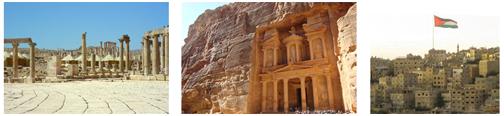
  • Petra in Ma'an, the home of the Nabateans, is a complete city carved in a mountain. The huge rocks are colorful, mostly pink, and the entrance to the ancient city is through a 1.25 km narrow gorge in the mountain — called the Siq.
  • Umm Qais, a town located on the site of the ruined Hellenistic-Roman city of Gadara.
  • Ajlun, famous for the Al-Rabad Castle.
  • Jerash, famous for its ancient Roman architecture, including the colonnaded streets, arches, Roman theaters, and the Oval Plaza.
  • Amman contains the Roman theater, in addition to several museums, where one may find remains of the Dead Sea Scrolls.
  • Al Karak contains an important castle from the times of Salah al-Din, known as Al-Karak Castle.
  • Madaba, well known for its mosaics.
  • The River Jordan, which is the river where Jesus of Nazareth was baptized, by John the Baptist.
  • Mount Nebo, where Moses was said to have gone to get a view of the Promised Land.
  • The Dead Sea - It is the lowest point on earth, 402 meters below sea level.
  • Aqaba is a city on the shore of the Gulf of Aqaba with numerous shopping centers, hotels and access to water sports.
  • Wadi Rum is a desert of mountains and hills located south of Jordan. It is popular for its sights, in addition to a variety of sports that are practiced there, such as rock-climbing. It is also known for its association with Lawrence of Arabia.
  • Fuheis, a beautiful city about 20 minutes north-west of Amman.

Acit 2012

  • About
  • Call for Papers
  • Jordan Wheather
  • Technical Committee
  • Steering Committee
  • Important Dates
  • Location and Venue
  • Organization
  • About Jordan
  • Accepted Papers
  • Published Papers (Only registered)
  • Camera Ready
  • Accommodation
  • Keynote Speakers
  • Conference Program

The International Arab Conference on Information Technology (ACIT) is a technical-scientific specialized conference. It is held periodically in the Arab homeland. All its bodies emerge from the Colleges of Computing and Information Society (CCIS).

Quick link

  • Home
  • STEERING COMMITTEE
  • ETHICS FOR PUBLISHING IN ACIT
  • ABOUT US
  • ACITFAQ

Contact


Zarqa University P.O. Box 132010

+962-5-3821100 / ext 1451

This email address is being protected from spambots. You need JavaScript enabled to view it.

  • ACIT
  • Editorial Board
  • Conference Ethics
  • General Secretariat
    • Secretariat Council
    • Basic Regulations
  • Pre. Conferences
    • ACIT 2024
    • ACIT 2023
    • ACIT 2022
    • ACIT 2021
    • ACIT 2020
    • ACIT 2019
    • ACIT 2018
    • ACIT 2017
    • ACIT 2016
    • ACIT 2015
    • ACIT 2014
    • ACIT 2013
    • ACIT 2012
    • ACIT 2011
    • ACIT 2010
    • ACIT 2009
    • ACIT 2008
    • ACIT 2007
    • ACIT 2006
    • ACIT 2005
    • ACIT 2004
    • ACIT 2003
    • ACIT 2002
    • ACIT 2001
    • ACIT 2000
  • Proceedings
    • ACIT'2024 Proceedings
    • ACIT'2023 Proceedings
    • ACIT'2022 Proceedings
    • ACIT'2021 Proceedings
    • ACIT'2020 Proceedings
    • ACIT'2019 Proceedings
    • ACIT'2018 Proceedings
    • ACIT'2017 Proceedings
    • ACIT'2016 Proceedings
    • ACIT'2015 Proceedings
    • ACIT'2014 Proceedings
    • ACIT'2013 Proceedings
    • ACIT'2012 Proceedings
    • ACIT'2011 Proceedings
    • ACIT'2010 Proceedings
    • ACIT'2009 Proceedings
    • ACIT'2008 Proceedings
    • ACIT'2007 Proceedings
    • ACIT'2006 Proceedings
    • ACIT'2005 Proceedings
  • About Us
  • ACITFAQ
  • Contact Us
  • +More
    • About CCIS
  • Acit2025
Top
We use cookies to improve our website. By continuing to use this website, you are giving consent to cookies being used. More details…